RECAP: Beyond #Abahambe – Implications for South Africa
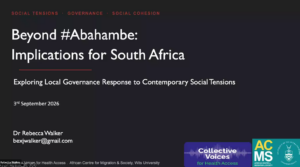
On 3 September, CPUT and the UWC School of Government, in collaboration with SAAPAM Western Cape Chapter, hosted a panel conversation exploring how local governance is responding to contemporary social tensions, from xenophobic mobilisation to the erosion of trust in state institutions.
Key insights from the panel:
Dr. Rebecca Walker (ACMS, Wits)
Dr. Walker’s study focused on civil society, using 80 Albert Street as a case study, from its apartheid history to the fire that displaced residents. She noted how blame shifted from state failure to victims, and how NGOs assisting those affected were themselves criticised. She referenced Section 41 of the Immigration Act, observing that the apartheid apparatus has been repurposed. While civil society has succeeded in litigation, political education, community work, and solidarity, she cautioned that social cohesion without structural change is not enough. “Real solidarity” must be the goal.
Mr. Shaun Phillips (CPUT)
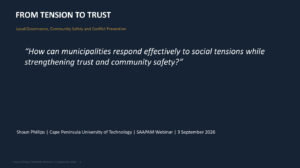
Phillips spoke on understanding tensions as a pathway to rebuilding the relationships that make safety possible. He argued that tension becomes dangerous when governance is absent, and that local government is best placed to address tensions and prevent escalation. He stressed that institutions like metro police cannot be the sole custodians of public safety.
Dr. Lungile Penxa (UWC)
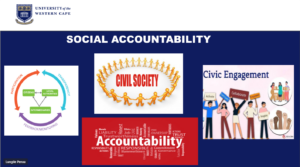
Penxa examined social accountability and the role of civic agency, building citizens’ capacity to hold government accountable. He emphasised the importance of human rights education and noted that local government success is linked to efforts from intergovernmental forums. He posed an important question: What does it mean to be truly inclusive in these platforms, and how meaningful are they in enabling citizens to achieve improved governance and service delivery?
The conversation was moderated by Prof. Isioma Ile and Dr. Msuthukazi Makiva (UWC).